




The infrastructure industry’s approach to AI should be one where people decide to work together in a spirit of shared learning, says Bentley Systems’ Mark Coates.
When Alan Turing asked, “Can Machines think?” in his seminal 1950 paper, he was working in Manchester, a city defined by revolution. Manchester first pioneered the industrial age with automated textile mills, then launched the digital age when engineers Tom Kilburn and Freddie Williams built the world’s first stored-programme computer. With his work on artificial intelligence, Turing ensured this city of revolutions would also inspire the next one.
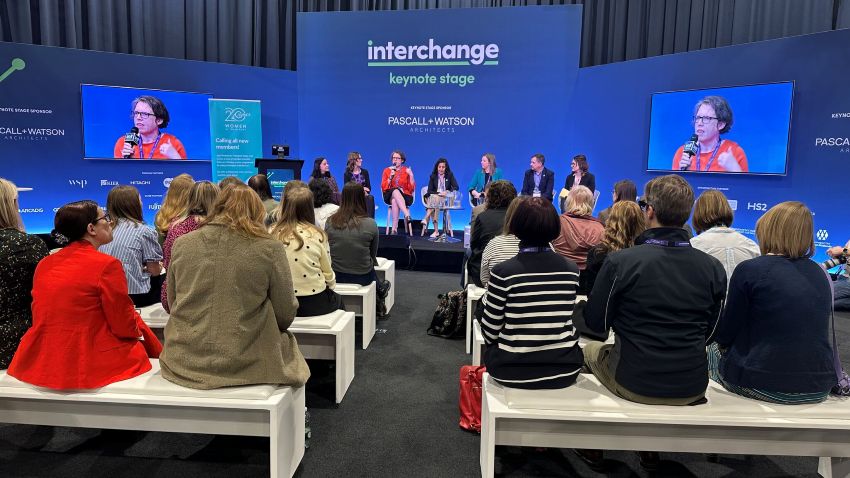
This unique history made Manchester the perfect backdrop for Interchange26, which took place earlier this month. Bentley’s infrastructure policy advancement team was proud to partner with the Infrastructure Client Group for a day of critical debate on the future of our industry in an age of AI and climate change. The day left me with a practical sequel to Turing’s question: if machines can think, how do we lead, collaborate and make decisions when insight is suddenly abundant, but certainty is still scarce?
Using AI to drive certainty
Several speakers at Interchange26 shared their thoughts on the opportunities that data and AI are opening up. With professor Bent Flyvbjerg’s large dataset showing that only 8.5% of projects are built on time and within budget, Jason Tucker, chair of the Infrastructure Client Group and director of commercial operations at Anglian Water Services, flagged a strategic opportunity for AI to provide more realistic project timelines. “In capital delivery,” he said, “we can use artificial intelligence to drive out the inherent optimism bias within our construction and delivery programmes to be more reliable and more certain in the prediction of our sort of delivery capability. The opportunity is significant.”
Steve Denton, head of civil engineering at WSP and vice president of the Royal Academy of Engineering, emphasised that to revive our aging infrastructure, good decision-making requires data frameworks to understand not just the condition of the asset today, but how it’s changing over time.
“The challenge when we’re managing infrastructure or assets fundamentally comes down to two questions,” he explained during his briefing on the academy’s Reviving our Ageing infrastructure report. “What is the optimal intervention, and when do we make it? Too much of the data that we collect today gives us a snapshot in time. It helps us to answer the first question, but it is woeful in enabling us to understand how things are changing,” Denton said.
This highlights a clear role for machine learning: to provide the insight and pre-emptive diagnosis needed to determine the optimal time for an intervention. The real opportunity for AI in infrastructure is not simply faster workflows, but deeper insight into how assets and systems perform and evolve over time. That is how we move from reporting the past to predicting what happens next.
Turing asked whether machines could think. In infrastructure, the more urgent question may be whether our organisations can learn quickly enough from what machines will show us.
The algorithm is ready – but are our leaders?
The potential is immense. Yet, as I revealed during Bentley Systems’ Year in Infrastructure event in Amsterdam in November 2025, a major gap exists. Findings from our global survey, conducted with Turner & Townsend, Mott MacDonald and Pinsent Masons, showed that while half (48%) of organisations said they are either trialing AI in selected areas or have implemented it in daily operations with plans to expand further, only a fifth (20%) have an AI policy that includes guidelines for use, governance, ethical implications, safety measures and related aspects.
The gap highlights the need not only for good governance and guardrails, but also the need for clear leadership and collaboration required to implement them.
Andy Sharples, major projects delivery director at Sellafield Ltd, addressed this question succinctly. “I’ve been involved in many programs for the last 30 years and they’re only as good as the people, the leadership, and the behaviours,” he said. “You can have world class systems. You can have 4D BIM, you can bring AI in, you can do all this really cool stuff. But if you don’t have the right behaviours and the right leadership at the helm, projects will fail,” said Sharples. He added: “I think at times, we don’t invest enough in people, the strength, the capability, the leadership.”
Liz Baldwin, southern integrated delivery director in the rail sector’s Southern Renewals Enterprise, echoed this focus with a rugby analogy. “The best rugby team or the best football team isn’t made up of the best players,” she said. “It’s made up of the people who are the best able to work together to make the best team.” She believes that in alliances, partners should choose each other based on this natural alignment.
Collaboration is the blueprint
These insights bring us back to a new version of Turing’s question: “How do humans behave, co-operate and collaborate in a world where machines can think?” How we answer that question as individuals, leaders and teams will define our industry for decades.
In the AI age, the strongest alliances will not be formed by who has the most tools, but by who can agree the rules of use, share data with intent and hold the line on behaviours when pressure arrives. The differentiator will be trust, and trust needs governance that people actually follow.
For me, the answer comes back to the most critical lesson of my career. That success is not built on systems or technology alone, but on the enduring power of partnership. It’s a theme I touched on in a piece last year about the process of creating successful partnerships and what we learned from convening 1,000 infrastructure leaders in 2025. I argued then that our challenges should not isolate us. When we surface them early, compare notes honestly and share what works, we shorten the learning curve for everyone.
Nowhere is this principle of bridge-building more powerfully demonstrated than in Manchester itself. Having grown up just down the road, I have watched the city’s remarkable transformation. That progress didn’t happen by accident. It was the direct result of a courageous, voluntary partnership between the ten boroughs of Greater Manchester, who chose to collaborate to create a more prosperous and investable region. It is a reminder that complex systems improve when incentives align, information is shared, and leaders choose cooperation over control.
The city’s journey proves what I have always believed. Whether you are building a team, an alliance, or a regional economy, the path to growth is the same. It is forged when people decide to work together in a spirit of shared learning. That is also how we should approach AI: not as a technology rollout, but as a collective shift in how we decide, how we govern and how we work together.
Machines may be able to think. Our advantage will come from whether we can collaborate well enough to act on what they reveal.
Mark Coates is vice president of infrastructure policy advancement at Bentley Systems.

